Posts

Scirpus rubricosus

Image
I have become increasingly aware and concerned about what appears to be a distinct species that is largely ignored/lumped in recent literature and completely unknown to most botanists. Several years ago when I first started working in wetland communities I was introduced to Scirpus cyperinus and its fitting misnomer “wool grass” (why not “wool sedge”?). Initially this was an easy species to recognize since it differed from other Midwestern Scirpus in having the following combination of morphological characters; average height of nearly two meters, folded (V-shaped) leaves (as opposed to the pleated M-shaped leaves of S. atrovirens ), large diffuse inflorescences and achenes subtended with very long flocculent bristles that give the mature inflorescence a woolly appearance. And life was good……until I started to notice that there was something wrong. There appeared to be two very different morphologies within what I was calling S. cyperinus . Here they are side by side: The photo o...

Dichanthelium werneri

Image
Like many eager Sasquatch documentarians before me, I feel compelled to share a video of an organism whose existence is denied by the scientific community. If you know Dichanthelium linearifolium, this creature should look different to you for reasons I point out in the video. Dichanthelium werneri had a brief but glorious history as a species until an uncharacteristically brash M.L. Fernald (1934) sunk it as a variety of D. linearifolium. I usually enjoy Fernald's take on botanical matters, but he really stepped over the limits of decency in his dealings with Panic Grasses. Many modern workers have buried it completely, largely based on Fernald's inertia I fear. With the exception of the treatment found in Hitchcock and Chase's "North American Species of Panicum" (from 1910), everyone says it is just a glabrous version of D. linearifolium. However, Hitchcock and Chase explain that the type specimen is in fact pubescent on the nodes and that this solid species mor...

Tragia ramosa: the spicy side of tactility

Image
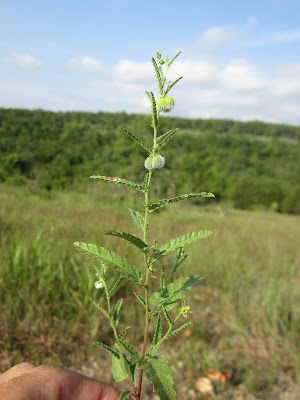
Ouch! Great Oden’s Raven! This is what I exclaim moments before I locate Tragia ramosa while fingering my way through a quadrat or as I sit for lunch in an open glade with a view and decide to lay back and reflect. The nasty needlish and nettle-like hairs of this gangly dweller of grassland understories deftly prick the skin and give you a dose of hot proteinaceous exudate that, tingling as it burns, lasts for hours after the encounter. Try to avoid it as I may, I become hostage to Tragia ’s maniacal “gotcha” game time and time again. That being said, I am a big fan. It just has that lovable bulldoggish quality to it. And the fruits, how amazing are those bristly gynophorous brutes? The complexity of Tragia ’s pain delivery system is fascinating and has been intimately studied and explained by Thurston (1976). As explained by Thurston, each stinging “hair” is made up of four cells. Three of these cells are parallel to each other in an elongate fashion. The base of the tria...

Juniperus virginiana; Open for Business

Image
I was preparing for a lecture on gymnosperms for my MST botany class and decided to collect specimens of male strobili from the Juniperus virginiana next to my house. You know, something to pass around, to smell, to feel. Male strobili are easily found. In fact, when in abundance on certain trees they give a tan hue that can be zeroed in on from quite a distance. The little cones, just a few millimeters long, were opened just enough to let the microspores slip through and onto the gusty superhighway that is the air on these warm days of late winter. I admire these reproductive gems every year and anticipate their awakening as one of the first stirrings of Spring. With spring Peepers chanting in the background, I shook a branch and delighted at the millions of encapsulated microgametophytes lofting on their journeys of hope, each wanting only to contribute its self-determined half to future eastern red cedars everywhere. The assumption of hope being my wish for them and an obvious st...

The Table Key to Carex sections

Image
Most botanists know that Carex is a difficult group to master. Not because the taxa within it are necessarily obscure, but because there are just so many that it is difficult to wrap your mind around them all. Most sedge-heads get in the habit of thinking of Carex in terms of the taxonomic sections within the genus. This breaks the species into more concrete groups and allows one to digest them by shared morphological traits. That being said, it is also difficult to keep the sections straight in one's head. In order to save my brain some strain I put together the following table key to the Carex sections. In order to use it, just start with the top row and work your way down the dichotomous choices to a group of 2-4 sections. Under each section is a list of characters that should distinguish each from the other. While the table key was devised for those Carex sections found in Missouri, it undoubtedly covers most sections in the Midwest (minus some obscure, rare or monotypi...

Prairie Poem

Image
Oh proud prairie Oh fertile shroud Rooted in the black depths of antiquity Spotted and swaying with varying degrees Of blue, green and golden pleasures A symphony of silent strength Where wind and grass collide To worship open expanse In you I confide Between the prayers of a Pleistocene sky The pressure of ice And the loft of loess I walk in silent search Of anything That can exist so freely As these erupting spirits of bloom In concert with birds, time Motion and tune Oh my miserable heart diced to bleeding pulsing squares Roads and crops Dust and barbed wire stares Pitted with rust That stain more red than ignorance My imprisoned prairie soul Dig deep Into ancient soils And find the us In what remains Of the plows crumbs And the cattle's waste Find the starry night So far away And let us sleep Together Under it And remain

Carex aureolensis

Image
It was just about a year ago when I first heard of Carex aureolensis . While walking with a fellow botanist he asked if I had noticed it in the Cyperaceae volume of the Flora of North America (vol. 23). I had not. He then informed me that it had been split out of Carex frankii , a species I had seen throughout eastern North America and in which I had never noticed much morphological variation. I believe my reaction was typical of most biologists upon hearing of taxonomic change in a group thought to be stable. My lips tightened, my heart rate increased and my vision became unfocused as my brain slammed into a low, deeply contemplative, gear. After a few minutes of test driving the idea in my head, I said with a slow and worried countenance “I don’t know if I buy that”. Trail talk is cheap. When I got home, I hit the index of FNA vol.23 and thumbed my way to page 519. Sure enough, there it was. I read the description, habitat and comments then flipped to the key char...