Posts

Vitaceae Seedlings; A Mystery No More
Image
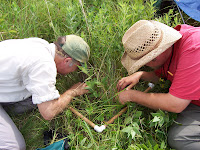
Sampling plants in quadrats is a challenging endeavor. It requires a taste for botany in its most raw and primitive state. Plants encountered in quadrats are almost always sterile and range from newborn seedlings to the withered remains of plants that may have senesced earlier in the year; and everything green in between. The field botanist spends countless hours in a growing season on his knees, head buried in vegetation, straining to use a hand lens at ground level in order to examine such subtleties as the red calluses on the teeth of Ceanothus americanus seedlings or the length of the ligule that separates Andropogon virginicus from Andropogon scoparius ( Schizachyrium lacks taxonomic credibility when applied to Little Bluestem). All this with the discomfort and sometimes fear that ticks, chiggers, horseflies, deerflies, yellow jackets, mosquitoes, gnats, spiders, snakes, falling limbs, storms, poison-ivy, heat and meth-heads illicit all around you. You know you have reached...

Lactuca....hirsuta?

Image
Lactuca hirsuta is one of the most under detected species of vascular plants in the Midwest. There I said it. It is completely off the radar for most folks, yet I see it with considerable frequency, at least here in the Ozarks. The USDA Plants website shows that it occurs in most every state northeast of Texas (north to MN and east to Maine and GA) yet it is listed from shockingly few counties in these states. I don’t know how this creature has escaped detection. Perhaps its anomalous distribution stems for the common precept that Lactuca canadensis can be distinguished from other Lactuca by the salmon/orange sap color. While this it true, one must then distinguish Lactuca hirsuta which also possesses this quality. This is easily done since L. hirsuta , as the name implies, is hirsute and L. canadensis is glabrous (disclaimer: some specimens of L. canadensis can be very slightly pubescent and some L. hirsuta can be sparsely pubescent but the vast majority are clear-cut). ...

A Sabatia Induced Rant

Image
In Richard Manning’s book “Grassland”, he wrote the following: I once heard a story of a man who had perfect recall, so he could never carry on a conversation. He had to live in isolation because the merest stimulus, the merest sentence from outside his own head would recall everything. All the information in his head would come tumbling forth in a great rush, and he would be crushed by the pain of seeing. I imagine that must be what it is like sometimes to be a botanist. I have been afield with many of them, and they are different, almost invariably quiet, distant. Undeniably, they see something different from what I see, as if the knowledge of the plants lifts a veil. The whole of it is there in the plants to be read, the full soul of a place, its life and the abuses of its life, the creation’s intentions and the manifest violation of those intentions. Botanists are our shamans. While this is clearly a romantic notion, there is some truth to it. Most botanists I know often reminisce ...

Argyrochosma dealbata

Image
While running transects across the grassy ledges and shelves of Hercules Glades Wilderness in Taney County Missouri, I paused to wipe the accumulation of sweat and juniper needles from my brow. As my heart rate approached conditionally normal, given the heat, my eyes focused on a tiny patch of bluish vegetation clinging to the otherwise salt and pepper façade of the sun and lichen aged limestone rock; the jutting and ever dissolving bones of the Ozarks. I leaned in. Puzzled, I looked around the ledge and discovered eight more small clumps of this little fern. I am accustomed to seen Cheilanthes feei on such rocks in such habitat, but this was strikingly different. In fact, Chelanthes feei was growing on the same ledge some 24 inches away and made for apt comparison. Hot blood squeezed through my brain and I was surprised when the name Notholaena dealbata surfaced; a fern I had only seen on glades along the Blue River in Kansas City. A quick cruise through several cold blooded refe...

Silphium asteriscus

Image
I truly enjoy the genus Silphium . It has an exciting yet strangely cohesive range of morphological variation. From humble colonies of S. integrifolium to the stoic and lofty stems of S. laciniatum , from the cool, rough texture of S. terebinthinaceum to the dense flocculence of S. mohrii (see below), they never fail to please. Here is a veiny crowd pleaser; the leaf of Silphium compositum from northern Alabama. In the Ozarks Highlands of Missouri, I annually anticipate the lemony blooms of S. asteriscus that begin dazzling the understory of our acid upland woodlands soon after the summer solstice. Silphium asteriscus (Starry Rosinweed, if you must) occurs throughout the southern United States in acidic woodlands. When young, it produces a basal rosette of ovate to lanceolate leaves. When it bolts to flower, the leaves are alternate along the stem, as opposed to S. integrifolium which is opposite leaved (and which never produces a basal rosette). In spite of the dramatic ran...

The Oddly Bearable Heat of Hercules Glades Wilderness

Image
A foggy sunrise over the balds and ridges of Hercules Glades Wilderness in southwestern Missouri has been my companion for most mornings the past two weeks. Temperatures have been starting in the low 70’s at sunrise and accelerating from there to the mid and upper 90’s by noon. The high humidity and lack of anything resembling a breeze has forced me to wake at 4am and have my quadrat buried deep in the dewy glade grasses by first light. By noon, I haul myself, an ever present load of ticks, and my near empty gallon jug of water a good mile to the nearest refugium where I reestablish a safe body temperature and stifle the heat induced randomness of my thoughts; thoughts that make one believe in the hallucinations induced by such spiritual paraphernalia as the Native American sweat lodge. Such thoughts were in my head yesterday morning when I glanced up from my vegetation sampling to see a 200 pound black bear walking broadside, watching me from no more than 60 feet away. I have always h...

Isotria verticillata (Orchidaceae)

Image
Three weeks ago, while on a field trip with the Missouri Native Plant Society, we stumbled upon a large population of Isotria verticillata at the peak of bloom. Anyone that has conducted surveys for rare, threatened or endangered species in the Midwestern and eastern United States has probably had this search image in their head (though maybe more so for its relative the federally threatened Isotria medeoloides ). Before I learned the vegetative field characters that distinguish this species from the often sympatric Medeola virginiana , I agonized over its identification. With practice and a visit to the herbarium, I learned they are quite distinct even when found in the sterile state. When sterile, both have a whorl of leaves at the top of the stem. However, Medeola has three (or sometimes five) distinct veins in each leaf while the venation of Isotria is inconspicuous and more reticulate. The venation of Isotria reminds me of the organization of juice sacks you find in an o...